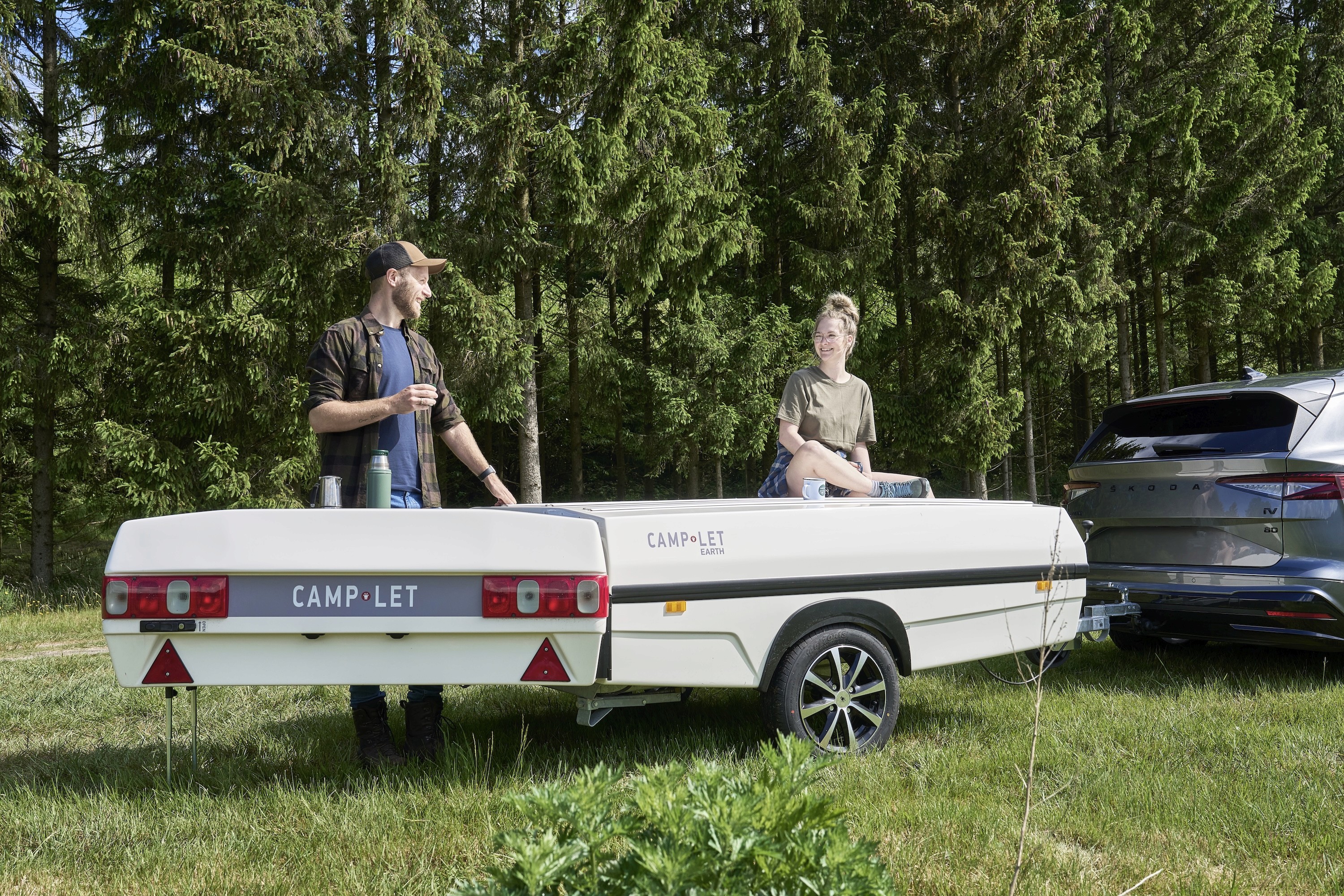
A Tesla Model Y with the tow package is rated for 3,500 lb. A Camp-let Earth is 595 lb empty and 700 to 900 lb packed, under Tesla's own threshold for trailer brakes, and it plugs into the car's factory 7-pin connector with nothing in between. Here is what Tesla's manual says, what you need, and what we have measured on range.
A Tesla Model Y with the tow package is rated to tow 3,500 lb (1,588 kg) with a 350 lb (159 kg) tongue limit. A Camp-let Earth weighs 595 lb (270 kg) empty and 700 to 900 lb (318 to 408 kg) packed for a trip, with 80 to 120 lb (36 to 54 kg) on the hitch. That is a quarter of the car’s rating. It is also under the 1,650 lb (750 kg) loaded weight at which Tesla recommends trailer brakes, which matters because the Model Y has no built-in brake controller and most trailers that owners try to tow with it need one. This one does not.
What Tesla’s Manual Says
Model Y, five-seat, all wheel sizes | Camp-let Earth | |
|---|---|---|
Maximum trailer weight | 3,500 lb (1,588 kg) | 700 to 900 lb (318 to 408 kg) packed |
Maximum tongue weight | 350 lb (159 kg) | 80 to 120 lb (36 to 54 kg) |
Trailer brakes | Recommended above 1,650 lb (750 kg) loaded. No built-in controller. | None fitted. None needed. |
Hitch receiver | 2 in (5 cm), with the tow package | 2 in ball |
Trailer connector | Built-in 7-pin | 7-pin |
The figures are Tesla’s, from the Model Y owner’s manual. The tow package is an option on every current trim, including the Standard, at about $1,000, and it must be ordered with the car or added afterward by Tesla Service. It is not a dealer accessory you bolt on in a driveway. The receiver takes a ball mount up to 8.7 in (22 cm) long with up to 0.8 in (2 cm) of rise; the ball mount itself is not included.
What You Need
The factory tow package. If your Model Y did not come with it, Tesla Service can add it.
A 2 in ball mount with a 2 in ball, within the length and rise limits above.
Nothing else. The Camp-let’s 7-pin connector plugs into the car’s 7-pin socket directly. No adapter, no brake controller, no weight-distributing hitch, no mirror extensions.
Trailer Mode
Plugging the Camp-let’s connector in while the car is in Park switches on Trailer Mode automatically. Tesla’s manual says it must stay on for the whole time you are towing. In Trailer Mode, Autopilot’s lane changes and some steering assistance are limited, the rear parking sensors are off, and the range estimate recalculates. A trailer icon on the screen confirms the lights are connected; red means a light circuit is faulty.
Range: What We Have Measured
Every guide to towing with a Model Y quotes a 40 to 50 percent range loss for an average trailer. A Camp-let is not an average trailer. It is 3 ft 1.5 in (0.95 m) tall on the road, below the car’s roofline, and it weighs a quarter of what those figures assume. Isabella has one measured data point for a trailer this size: in 2023, Camp-let ran a Volkswagen ID.4 with an 82 kWh battery over the same 19 mile (30 km) road route at up to 50 mph (80 km/h), once without a trailer and once towing a 595 lb (270 kg) Camp-let. Solo, the car returned 3.85 mi/kWh (6.20 km/kWh). Towing, 3.48 mi/kWh (5.60 km/kWh). That is a 9.7 percent loss, which on the ID.4’s pack works out to roughly 316 miles solo and 285 miles towing.
Be clear about what that is and is not. It is one car, one trailer, one short route at 50 mph, run by Camp-let rather than an independent tester. It is not a Model Y and it is not a highway test. The reason it should transfer is that the two things that cost an EV range when towing are weight and frontal area, and the Camp-let is the same weight and the same height behind a Model Y as it was behind an ID.4. Isabella has not measured a Model Y with a Camp-let behind it, and this guide will not invent a number. When we have one, it goes here.
The same test runs showed something more useful to a Model Y owner than any single percentage: the ID.4 towing the Camp-let at 50 mph used less energy per mile than the same car driving solo at 81 mph (130 km/h). Speed costs more range than this trailer does. A Model Y towing a Camp-let at 65 mph instead of 80 recovers more range than the Camp-let takes away.
The Limit That Actually Matters
Charging stops. Superchargers are laid out for cars, and a Model Y with a trailer behind it does not fit a pull-in stall. In practice that means unhitching at some stops, which with a Camp-let is a one-person job of a few minutes, or finding a pull-through stall. Tesla’s trip planner does not reliably account for a trailer, so give the first trip more margin than the screen suggests.
Nothing Tesla-Specific Required
The Camp-let needs nothing made for a Tesla. Any Model Y with the tow package and a 2 in ball tows it, and the same holds for every EV in the towing guide with a 7-pin socket and a 2 in receiver.
If you are weighing a Camp-let against the hard-sided trailers a Model Y is also rated for, Camp-let Earth vs. Small Travel Trailers works through that with real weights, and the towing guide covers the full vehicle list, gas and electric. If you have towed a Camp-let behind a Model Y and have a range figure, or want to confirm your configuration before ordering, contact us. We will put a real number on this page the day we have one.