A family that wants beds for four and a dry place to sit when it rains ends up looking at two very different trailers. One weighs 595 lb and opens into a canvas room. The other weighs three to five times that and brings its own walls, bathroom, and furnace. The gap between them decides the car in your driveway.
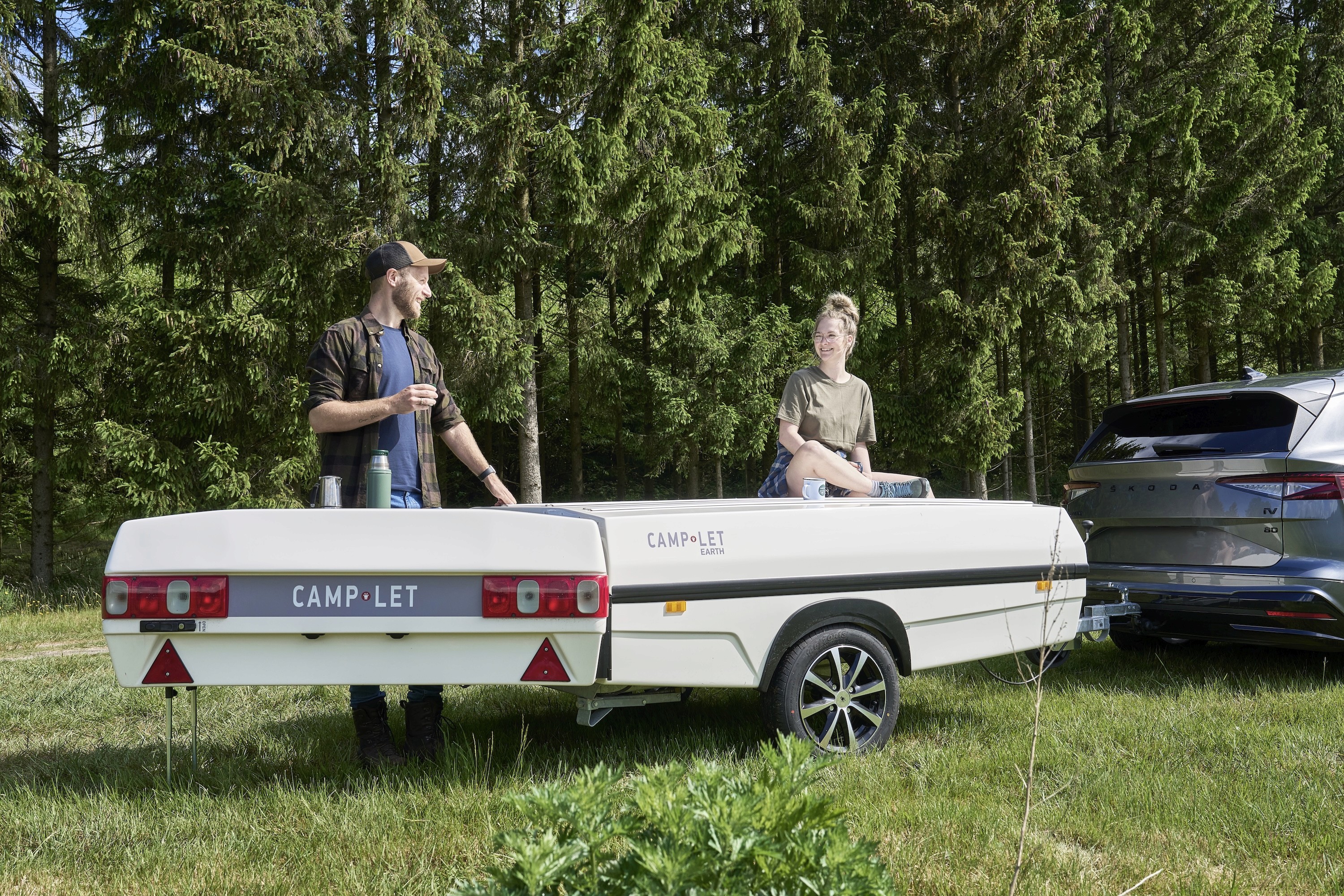
A family that wants beds for four and a dry place to sit when it rains ends up looking at two very different trailers. One is a tent trailer: Camp-let Earth, 595 lb (270 kg), a fiberglass trailer that opens into two sleeping cabins and a 194 sq ft (18 m²) canvas living room. The other is a small travel trailer: a hard-sided box, 1,900 to 3,300 lb (862 to 1,497 kg) before you load it, with a bathroom, a furnace, and a water tank inside. Same family. Same problem. Opposite answers.
This comparison uses three travel trailers a family of four actually shops. The Scamp 16 is the lightest hard-sided trailer that sleeps four, molded fiberglass, sold factory direct. The Forest River R-Pod is the trailer sold on the promise that your SUV can tow it, which is the exact promise Camp-let makes, so it is the fair test. The Jayco Jay Flight SLX 175BH is the bunkhouse a dealer puts in front of a family of four, and the one with a published starting price. All figures are the manufacturers’ own for 2026 unless noted.
At a Glance
Camp-let Earth | Scamp 16 | Forest River R-Pod 171 | Jayco Jay Flight SLX 175BH | |
|---|---|---|---|---|
Dry weight | 595 lb (270 kg) | From 1,900 lb (862 kg) | 2,529 lb (1,147 kg) | 3,245 lb (1,472 kg) |
Hitch weight | 80 to 120 lb (36 to 54 kg) | 175 to 250 lb (79 to 113 kg) | 360 lb (163 kg) | 335 lb (152 kg) |
Loaded weight to plan for (GVWR) | 700 to 900 lb (318 to 408 kg) as packed | 3,500 lb (1,588 kg) | 4,029 lb (1,828 kg) | 4,600 lb (2,087 kg) |
Trailer brakes | Not required. Tows unbraked. | Electric brakes standard | Electric brakes standard | Electric brakes standard |
Minimum tow rating | 1,000 lb (454 kg) | 3,500 lb (1,588 kg) to tow it loaded | 4,000 lb (1,814 kg) to tow it loaded | 5,000 lb (2,268 kg) to tow it loaded |
Closed length | 10 ft 7 in (3.23 m) | 16 ft (4.88 m) | 19 ft (5.79 m) | 22 ft 1 in (6.73 m) |
Closed height | 3 ft 1.5 in (0.95 m) | 7 ft 9 in (2.36 m), 8 ft 10 in (2.69 m) with A/C | 9 ft 10 in (3.00 m) | 9 ft 7 in (2.92 m), 10 ft 3 in (3.12 m) with A/C |
Living space | 194 sq ft (18 m²) canvas room, 7.4 ft (2.3 m) at the peak | Inside the shell, 6 ft (1.83 m) interior height | Inside the box | Inside the box, 6 ft 6 in (1.98 m) interior height |
Sleeps | 4 standard, 6 with Annex | Up to 5 | 3 | Up to 6 |
Beds | Two cabins, 55 x 79 in (140 x 200 cm) | Rear bed 76 x 54 in (193 x 137 cm), front bunk rated 150 lb (68 kg) | Rear queen, convertible dinette | Bunks rated 300 lb (136 kg) single, 600 lb (272 kg) double |
Bathroom | None | Shower and toilet on bathroom layouts | Wet bath, shower and toilet | Toilet with 19.9 gal (75 L) black tank, tankless water heater |
Furnace | None. Portable heater if you want one. | Standard on Deluxe, optional on Standard | Forced-air heat | 19,000 BTU |
Fresh water | None. Containers. | 12 gal (45 L) | 30 gal (114 L) | 30 gal (114 L) |
Refrigerator | None | Standard | 12V compressor fridge | Not listed on spec page |
Air conditioning | None | Optional | 15,000 BTU standard | Available, adds 8 in (20 cm) of height |
Hard-sided campgrounds | Not permitted | Permitted | Permitted | Permitted |
Setup at camp | 15 to 20 minutes, 11 stages | Unhitch, level, plug in | Unhitch, level, plug in | Unhitch, level, plug in |
Fits in a garage | Yes, beside a car | Only with an 8 ft (2.44 m) door and no A/C | No | No |
Price | From $13,695 | Factory direct, quote only. No published list price. | MSRP $33,160. Dealer pricing seen at $22,995. | From $17,318 |
What Both Have in Common
Both are built for the same family. Two adults, two children, maybe a dog. They want everyone in a real bed, they want somewhere to be when the weather turns, and they want to pull it with something that is not a pickup truck. That is the brief for a small travel trailer and it is the brief for a Camp-let Earth. The rest of this guide is about what each one gives up to meet it.
None of these is a bad trailer. The question is what the walls weigh, what that weight costs you, and whether it is worth it to your family.
The Weight Gap Is the Whole Guide
Camp-let Earth weighs 595 lb (270 kg) empty and 700 to 900 lb (318 to 408 kg) packed for a trip. The lightest hard-sided trailer that sleeps four, the Scamp 16, starts at 1,900 lb (862 kg) empty and is rated to 3,500 lb (1,588 kg) loaded. The R-Pod 171 is 2,529 lb (1,147 kg) empty, 4,029 lb (1,828 kg) loaded. The Jay Flight SLX 175BH is 3,245 lb (1,472 kg) empty, 4,600 lb (2,087 kg) loaded. Loaded is the number that matters, because that is what your car is pulling on the way to the lake.
Those numbers are three to six times the Camp-let. That is not a difference of degree. It changes the category of vehicle you need, whether you need a brake controller, where the trailer lives at home, and what a trip costs in fuel. Every section below is a consequence of this one.
What It Means for the Car in Your Driveway
Camp-let Earth needs a tow rating of 1,000 lb (454 kg), a 2 in ball, and a 7-pin connector. It tows unbraked. The towing guide lists 27 vehicles with their factory ratings; nearly every one of them qualifies, including a Honda CR-V at 1,500 lb (680 kg), a Subaru Forester at 1,500 lb, and a Toyota RAV4 at 1,750 lb (794 kg).
None of those three vehicles can tow any trailer in this comparison. A loaded Scamp 16 at 3,500 lb (1,588 kg) wants a Subaru Outback XT or Wilderness, rated 3,500 lb, running at its limit, or a Toyota Highlander. A loaded R-Pod 171 at 4,029 lb (1,828 kg) wants a Highlander, a Honda Pilot AWD, or a 4Runner. A loaded Jay Flight 175BH at 4,600 lb (2,087 kg) wants a 4Runner at 6,000 lb (2,722 kg), a Grand Cherokee, or a non-hybrid Highlander rated 5,000 lb (2,268 kg), and it is still a serious tow for any of them.
All three travel trailers come with electric brakes as standard, which means a brake controller in the tow vehicle. Many crossovers do not have one and some cannot easily take one. The Camp-let has no brakes to control.
Put plainly: if your family car is a compact or mid-size crossover and you do not want to replace it, the hard-sided trailers on this page are not available to you. If you already own a 4Runner, a Highlander, a Pilot, or a truck, the weight gap is real but it is not a constraint, and the rest of this guide is about what you prefer rather than what you can do.
Beds: Fixed Bunks or Two Cabins
A bunkhouse travel trailer solves beds for four with a fixed bed for the adults and stacked bunks for the kids, inside one room. The Jay Flight 175BH sleeps up to six that way. The Scamp 16 sleeps up to five with a rear bed and a front bunk rated for 150 lb (68 kg), which means a child. The R-Pod 171 sleeps three, a queen and a converted dinette, so a family of four is already looking at a heavier R-Pod floorplan.
Camp-let Earth sleeps four in two raised cabins, 55 x 79 in (140 x 200 cm) each, on opposite sides of the living room, with a zip door between each cabin and the room. Parents in one, kids in the other, a room between them. The Annex adds two more. Nobody climbs a ladder and nobody sleeps on a converted table.
The travel trailer’s beds are inside hard walls, which is warmer and quieter. The Camp-let’s beds are separate rooms, which is something a 16 ft box cannot offer at any price. Which matters more depends on your children’s ages and how lightly you sleep.
Living in Rain: A Box or a Room
Inside a small travel trailer, the living area is the floor between the bed and the galley, with a dinette that seats four if they are friendly. The Scamp has 6 ft (1.83 m) of headroom; the Jayco has 6 ft 6 in (1.98 m). It is weatherproof in the fullest sense: hard roof, hard walls, a door that latches, a furnace with a thermostat. A rainy day inside is cramped but entirely dry and entirely warm.
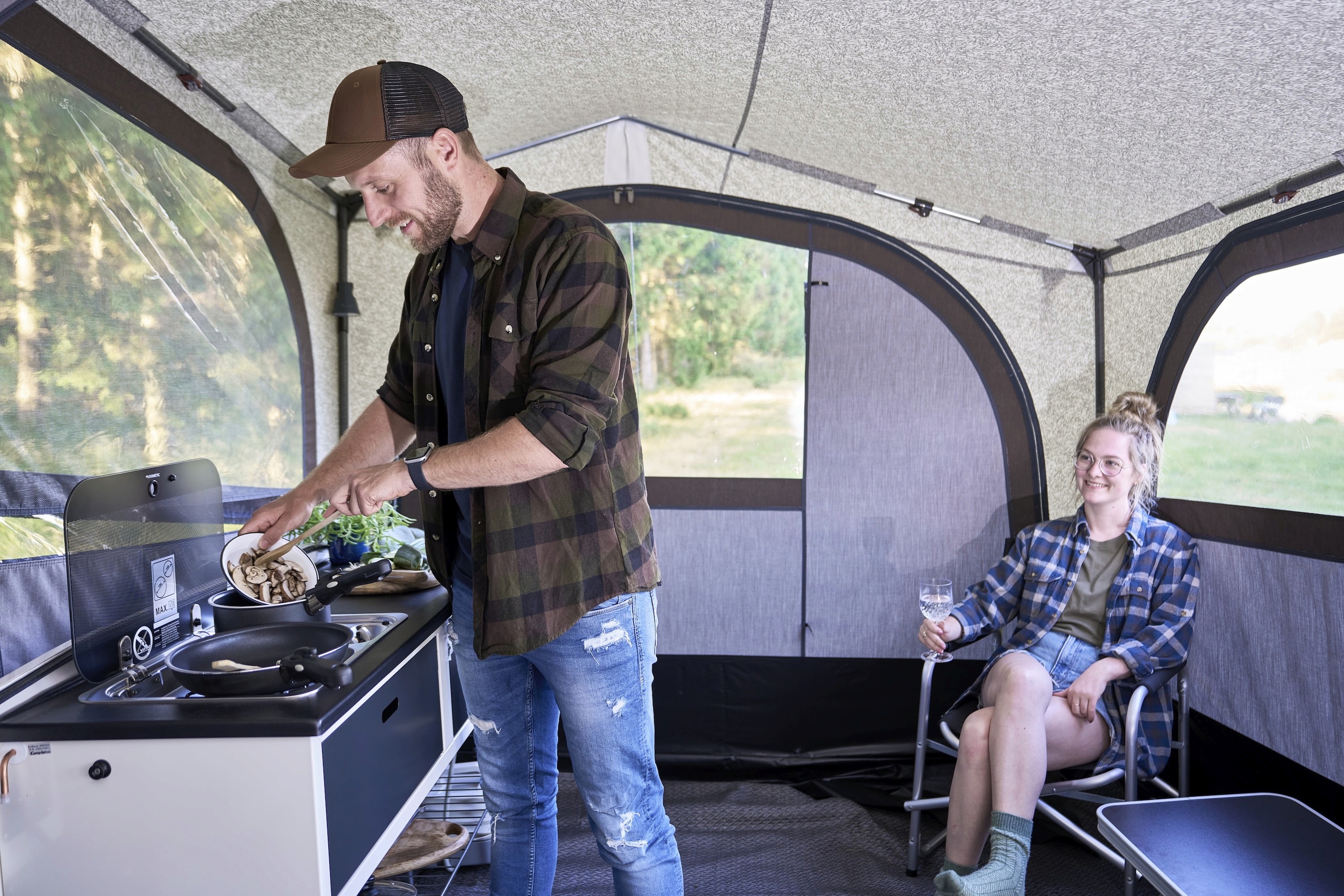
Camp-let Earth’s living room is 194 sq ft (18 m²) of floor under a canvas roof with a 7.4 ft (2.3 m) peak, screened windows, a door, and room for a table, four chairs, and the kitchen module. A rainy day inside is spacious, dry, and as warm as the portable heater you brought. It is canvas, so you hear the rain. One is a cabin. The other is a porch with walls. Most families know which they want once it is put that way.
The Bathroom, Honestly
Camp-let Earth has no bathroom. Not a wet bath, not a cassette toilet, nothing built in. You use the campground’s, or a portable toilet you bring and empty yourself. For many families this is the end of the comparison, and it should be said in the first third of the guide rather than buried at the bottom.
The Scamp 16 offers a shower and toilet on its bathroom layouts, with a 6 gal (23 L) black tank. The R-Pod 171 has a wet bath, a shower and toilet in one molded compartment, with 30 gal (114 L) tanks. The Jay Flight 175BH carries a 19.9 gal (75 L) black tank, which means a toilet, and a tankless water heater. These are real bathrooms, and a bathroom you do not have to walk to at 2 a.m. with a four-year-old is worth a great deal of trailer weight to the right family.
If an onboard toilet is a requirement, buy the travel trailer. The Camp-let cannot meet that requirement and this guide will not pretend otherwise.
Heat, Power, and Water
A travel trailer brings its systems with it. The Jay Flight has a 19,000 BTU furnace and 30 gal (114 L) of fresh water on board. The R-Pod has forced-air heat, a 12V fridge, a 15,000 BTU air conditioner, and the same 30 gal. The Scamp has a fridge as standard, a furnace on the Deluxe, and 12 gal (45 L) of water. Turn a dial and the trailer is warm. Open a tap and water comes out.
Camp-let Earth has none of this built in. Heat is a portable heater. Water is containers. Cold food is a cooler or a 12V box you bring. Power is a battery you bring. The systems are most of what the other trailers weigh, and leaving them out is how a trailer that sleeps four comes in at 595 lb (270 kg). A family that wants to arrive and be warm in five minutes will be happier in the box.
Setup and Departure
A travel trailer is ready when the handbrake is on: unhitch, level, plug in, done. Camp-let Earth sets up in 11 stages, 15 to 20 minutes once you know the sequence and 45 to 60 minutes the first time; the setup guide walks through every stage. Leaving camp runs the same in reverse, and if it rained overnight the canvas comes home wet and needs to be opened and dried within a day or two.
For a family that moves campsites every night, this is a real cost and the travel trailer wins it outright. For a family that stays three or four nights, twenty minutes on the first afternoon is a small price for a room three times the size.
Storage at Home
Camp-let Earth is 10 ft 7 in (3.23 m) long and 3 ft 1.5 in (0.95 m) tall. It fits beside a car in a single garage bay, under a carport, or in a corner of a shed. A Scamp 16 is 7 ft 9 in (2.36 m) tall, 8 ft 10 in (2.69 m) with the air conditioner, and needs a tall garage door or a driveway. An R-Pod at 9 ft 10 in (3.00 m) and a Jay Flight at 9 ft 7 in to 10 ft 3 in (2.92 to 3.12 m) live outside: a driveway if your street and your HOA allow it, a storage lot if they do not. Storage lot fees are a real cost over the life of a trailer and almost never come up at the dealership.
Cost: Looking at the Full Picture
Camp-let Earth is $13,695 before freight, which runs $599 to $1,999 by region, and before the optional kitchen module. A Jay Flight SLX 175BH starts at $17,318. An R-Pod 171 lists at $33,160 with dealer pricing seen at $22,995. Scamp sells factory direct and does not publish prices; you build a quote.
On sticker, the Jay Flight is the closest, and for about $3,600 more than a Camp-let it includes a furnace, a bathroom, bunks for four, and 30 gallons of water. That is more trailer for the money and it should be said plainly.
The costs that follow are where it turns. A travel trailer may need a tow vehicle you do not own, which is the single largest line in the whole comparison. It needs a brake controller installed. It needs somewhere to live, which may be a monthly fee. And it pulls 3,500 to 4,600 lb (1,588 to 2,087 kg) through the air at highway speed, which shows up at every fuel stop. Over several seasons, the trailer with the lower sticker is often not the one that cost less.
Where the Travel Trailer Wins
Here is the other column, stated as the real reasons a family chooses one.
A toilet and shower inside. For a family with young children, or anyone camping where facilities are far or poor, this alone decides it.
A furnace with a thermostat and a hard roof. Cold-weather camping is a different experience inside insulated walls.
Arrival in rain, wind, or dark with nothing to set up and nothing to dry out afterward.
Hard-sided campground access. Campgrounds in grizzly country that allow no tents or tent campers, including the RV park at Yellowstone’s Fishing Bridge, allow all three of these trailers and not the Camp-let.
Security. The whole trailer locks, including your gear, while you are away from camp.
Resale. Jayco, Forest River, and Scamp have deep used markets in the US. Camp-let is new here and does not yet.
If two or more of those are requirements rather than preferences, the travel trailer is the right answer and the weight is the price of it.
Who Should Buy Which
A small travel trailer is the right choice if:
You need a bathroom inside the trailer.
You already own a vehicle rated for 4,000 to 5,000 lb (1,814 to 2,268 kg) with a brake controller, or you are buying one anyway.
You camp in grizzly country where hard-sided units are required.
You move most nights and want to arrive and be done.
You have a driveway or a storage space and are fine with the trailer living outside.
Camp-let Earth is the right choice if:
Your tow vehicle is a crossover, a small SUV, a sedan with a hitch, or an EV, and replacing it is not on the table.
You stay in one place for several nights and want a living room you can stand in, with the children’s beds in a separate room.
A campground bathroom or a portable toilet is acceptable to your family.
The trailer has to fit in the garage beside a car.
You would rather carry the shelter and bring your own systems than carry the systems and give up the room.
The Right Answer Depends on the Car You Already Own
Most of this decision is made before anyone looks at a trailer. If the family car is rated for 5,000 lb, a small travel trailer is a reasonable and complete choice, and the Camp-let is the one that trades a bathroom for a room and a garage. If the family car is a CR-V, a Forester, or a RAV4, the travel trailer is not a choice at all without a second vehicle, and the Camp-let is the trailer that sleeps four behind the car in the driveway. If you are still deciding, What Is a Tent Trailer? explains the category from the start, and Camp-let Earth vs. Pop-Up Campers covers the soft-sided trailer that sits between these two.