Nov 13, 2025
Innovations
Why Canvas Still Matters: The Technical Advantage of Isabella Awnings
A technical deep-dive into materials, engineering, and the science behind durability.
Category
Innovations
Reading Time
10 Min
Guided by the principles of founder Søren Odgaard
In the early days of Isabella, Søren Odgaard spent as much time repairing tents as he did sewing them. Customers returned with stories of windstorms, heavy rain, and long days of sun. Some fabrics stretched. Some leaked. Some shrank. But the ones built from dense canvas — woven intentionally, not cheaply — held their shape.
Søren believed something simple that still guides Isabella today:
The material should tell the truth before the product ever does.
Over the next 65+ years, that principle shaped everything from our acrylic textiles to our CarbonX poles and our seam construction. And as Isabella enters the U.S. market, where polyester is standard and disposable gear is common, the question is worth answering clearly:
Why does canvas still matter?
And what makes Isabella’s approach fundamentally different?
Let’s start with the technical truth.
The Science Behind Acrylic Canvas
Built for longevity, heat regulation, and real weather
Unlike polyester, the dominant U.S. tent fabric, acrylic canvas is engineered for performance, stability, and comfort.
Below are real, measurable attributes that define the difference.
1. Weight & Density (GSM)
Most acrylic fabrics used in European awnings fall between:
280–320 GSM (grams per square meter)
This density is crucial for:
shape retention
tear strength
thermal stability
noise reduction
Polyester awnings typically fall in the 140–180 GSM range — half the density, which is why they flap, stretch, and degrade quickly.
2. UV Resistance (Blue Wool Scale)
Acrylic canvas (solution-dyed) achieves:
7–8 out of 8 on the Blue Wool Scale
= Excellent UV stability
= Long lifespan without brittleness or cracking
Surface-dyed polyester typically rates:
4–5 out of 8
= Noticeable fading within 1–3 seasons
= Accelerated fabric breakdown
This is why polyester awnings often fail at the seams or crack along fold lines.
3. Breathability & Condensation Control
Acrylic canvas fibers are porous. The weave allows controlled airflow.
Effects:
lower interior humidity
drastically reduced condensation
improved sleep climate
more stable temperature day and night
Polyester, especially coated fabrics, traps moist air.
This is the primary reason RVers wake up to “wet walls.”
4. Tear Strength & Structural Integrity
Acrylic canvas maintains higher tear resistance due to fiber length and weave tension.
Industry ranges:
Acrylic: ~20–30% higher tear strength under load
Polyester: prone to elongation and deformation
Isabella pairs acrylic canvas with:
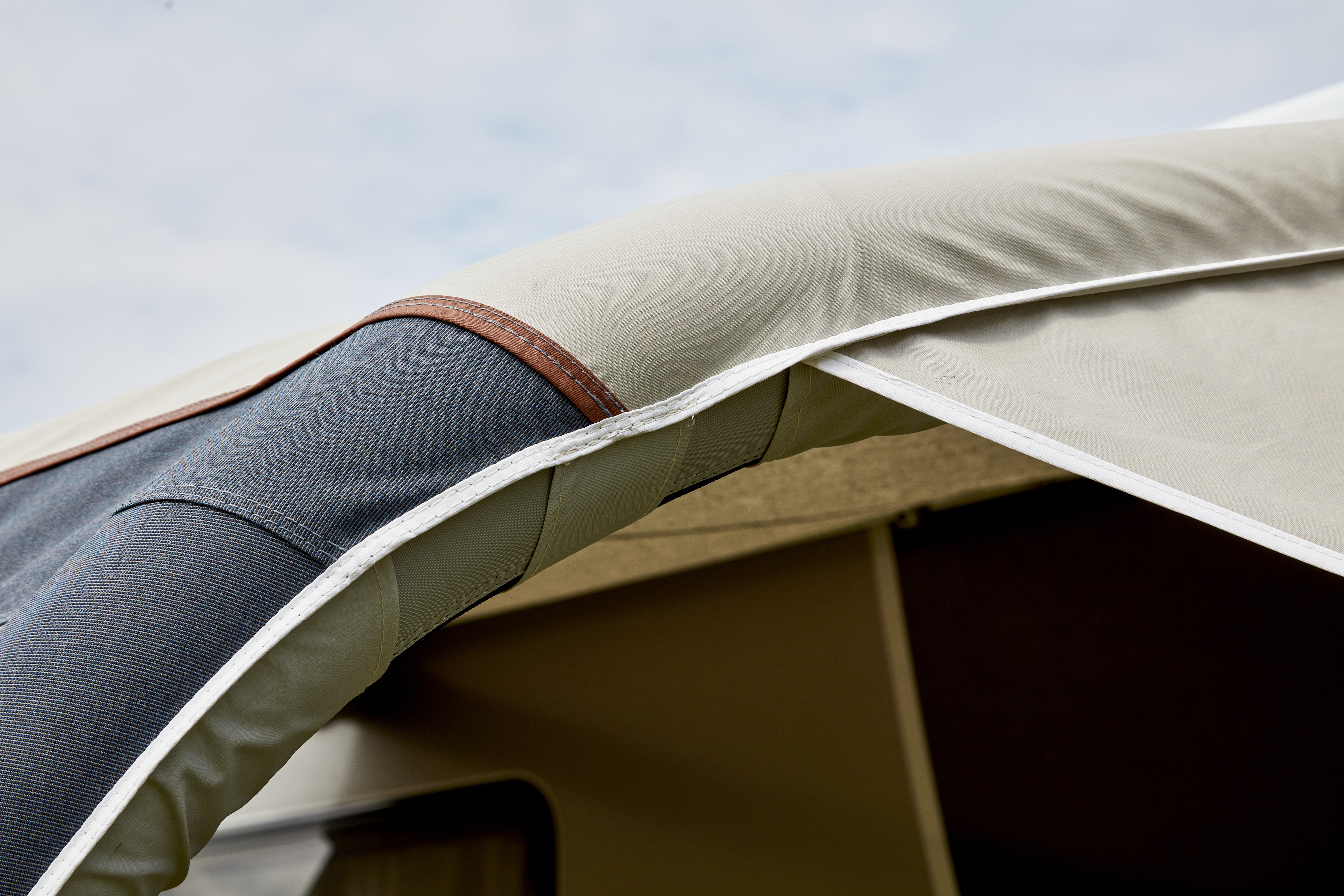
double-folded roof seams
PVC corner reinforcements
anti-wick thread
longitudinal reinforcement bands
These details directly prevent fabric creep and seam failure.
The Engineering Behind the Frame
Strength is a design choice, not an accident
In the 1970s, Ivan and Peder Odgaard began experimenting with materials inspired by ski pole construction. This led to what are now the CarbonX and Zinox platforms.
CarbonX Composite Poles
A proprietary blend of:
carbon fiber (for rigidity)
fiberglass (for controlled flex)
cross-wound layers for torsion control
topped with a protective lacquer
Key performance attributes:
high tensile strength
minimal weight
corrosion-proof
stable under repeated flex cycles
maintains geometry under wind load
Polyester awning frames are commonly paired with aluminum poles — lighter, cheaper, but prone to bending under torsion.
Zinox Steel (Hot-Galvanized)
ISO-certified high-strength steel
Inside + outside galvanization for uniform corrosion protection
Ultra-stable in high wind scenarios
Ideal for long-term or seasonal setups
Layer structure:
Transparent lacquer
Aluminum/zinc coating
Structural steel
Aluminum/zinc coating
Transparent lacquer
This structure significantly delays corrosion penetration.
Zinox MegaFrame
For all-year and permanent installations:
32mm diameter steel (vs typical 22–25mm)
1.2mm wall thickness
welded corners
MegaFix tension locks
This frame is designed to withstand:
snow load
seasonal wind cycles
prolonged UV exposure
frame fatigue
In real European use, these frames sit year-round, with stability measured in years, not weekends.
Comparison: Acrylic Canvas vs Polyester
A Scandinavian-direct, factual breakdown
Attribute | Acrylic Canvas (Isabella) | Polyester (Typical U.S. Awnings) |
|---|---|---|
GSM (Density) | 280–320 GSM | 140–180 GSM |
UV Resistance | 7–8/8 Blue Wool | 4–5/8 Blue Wool |
Breathability | High | Low |
Condensation | Minimal | High |
Tear Strength | Excellent | Moderate |
Shape Retention | Stable for years | Loses tension quickly |
Noise in Wind | Low | High |
Expected Lifespan | 10–20 years | 2–5 years |
Ideal Use | Long-term camping, varied climates | Short-term, light use |
Repairability | High | Low |
It’s not a matter of “which is better.”
It’s a matter of different philosophies:
One is made for real weather.
The other is made for speed and cost savings.
Testing: Where Isabella Gets Its Data
Isabella’s materials are tested through real-world use across more climates than almost any RV accessory brand:
Norway (wind, sleet, snow)
First winter awnings tested under extreme subarctic conditions.
Bahrain (heat, UV, sand)
1960s expedition tents proven under desert temperatures.
Northern Europe (seasonal storms)
Long-term seasonal setups in Denmark, Sweden, Norway.
Alpine regions (snow load)
Zinox and MegaFrame subjected to heavy weight accumulation.
Why This Matters for American RVers
The U.S. covers extreme climatic diversity:
Southwest UV
Midwest storms
Pacific Northwest rain
Gulf humidity
Rocky Mountain temperature swings
Most U.S. RV awnings were not designed for this reality. Isabella’s materials were.
What you get:
cooler interiors
quieter nights
less fabric fatigue
fewer replacements
safer structures
a living space you can trust
A campsite should feel like a small, dependable home.
Canvas makes that possible, and acrylic canvas keeps it that way for decades.
Carrying Forward Søren’s Philosophy
Søren’s view was always practical:
Build for weather, and comfort will follow.
We still follow that rule.
Choose honest materials.
Avoid shortcuts.
Prioritize performance over convenience.
Let durability speak more quietly, and longer, than marketing ever could.
Canvas still matters because weather still matters.
And good materials still matter.
This is the backbone of Isabella’s design, in Denmark, and now in America.