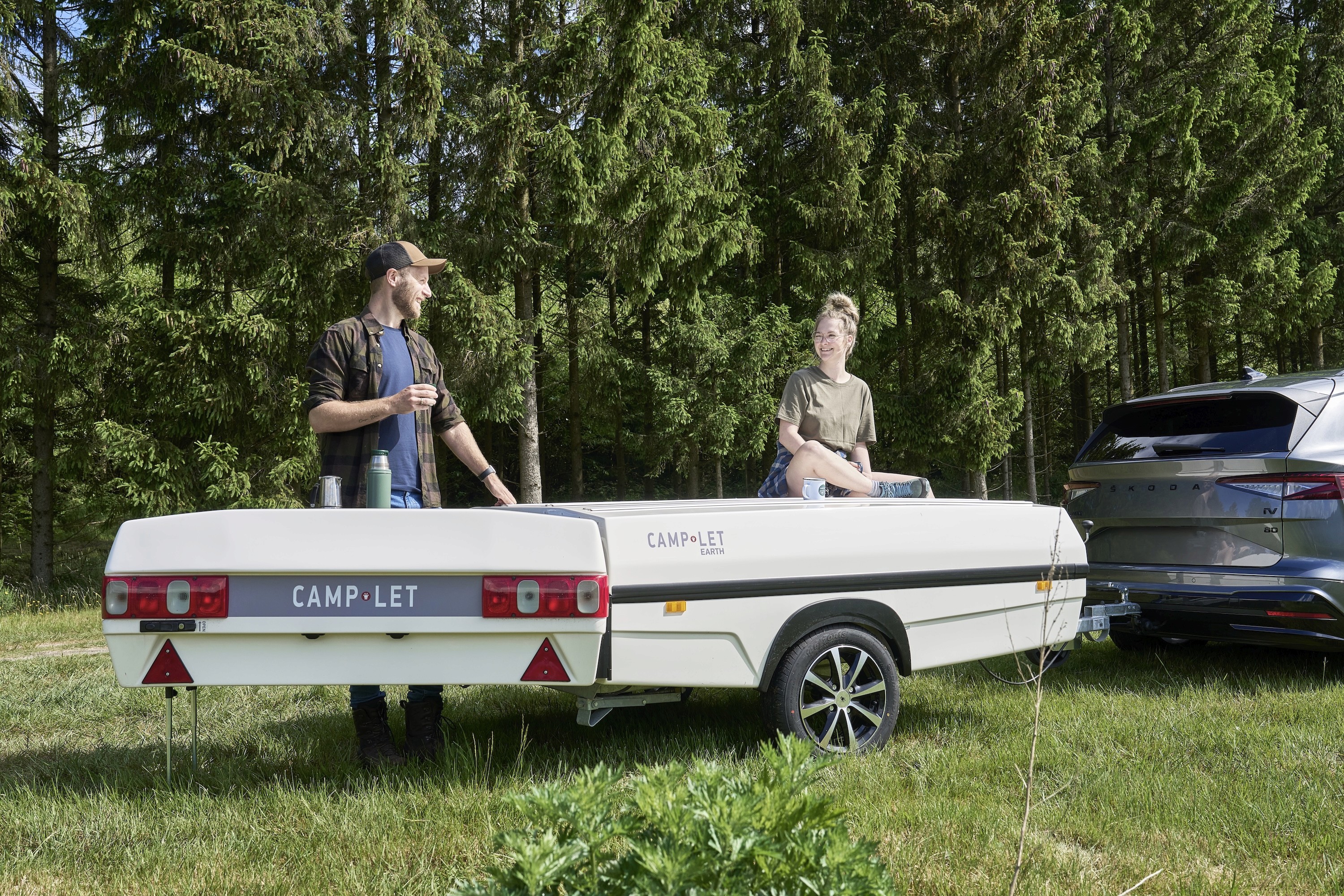
A Rivian R1S is rated to tow 7,700 lb and an R1T up to 11,000 lb. A Camp-let Earth is 595 lb empty and 700 to 900 lb packed, and every R1 leaves the factory with the 2 in receiver and 7-pin connector it needs. The question is not whether an R1 can tow a Camp-let. It is what a trailer this small does to the range of a truck built for trailers ten times its weight.
A Rivian R1S is rated to tow 7,700 lb (3,493 kg). An R1T is rated 7,700 to 11,000 lb (3,493 to 4,990 kg) depending on battery and motors. A Camp-let Earth weighs 595 lb (270 kg) empty and 700 to 900 lb (318 to 408 kg) packed for a trip, with 80 to 120 lb (36 to 54 kg) on the ball. The lowest rating in the R1 lineup is more than eight times the trailer’s packed weight. The Camp-let has no brakes and needs none, so the truck’s integrated brake controller has nothing to do, and the weight-distributing hitch Rivian requires above 5,000 lb (2,268 kg) does not enter into it.
What Rivian Says
Rivian R1S | Rivian R1T | Camp-let Earth | |
|---|---|---|---|
Maximum trailer weight | 7,700 lb (3,493 kg) | 7,700 to 11,000 lb (3,493 to 4,990 kg) | 700 to 900 lb (318 to 408 kg) packed |
Without a weight-distributing hitch | 5,000 lb (2,268 kg) | 5,000 lb (2,268 kg) | Not needed |
Hitch receiver | 2 in (5 cm), Class IV, standard | 2 in (5 cm), Class V, standard | 2 in ball |
Trailer connector | 7-pin, standard | 7-pin, standard | 7-pin |
Trailer brakes | Integrated controller | Integrated controller | None fitted. None needed. |
The figures are Rivian’s. The R1T rating splits by generation and battery: every 2022 to 2024 truck is rated 11,000 lb, while 2025 and later trucks with the Standard or Large pack and dual motors are rated 7,700 lb and Max pack trucks keep 11,000 lb. Every R1S, any year, any pack, is 7,700 lb. Rivian does not publish a single tongue weight limit; its guidance is roughly 10 percent of the loaded trailer weight. A Camp-let puts 80 to 120 lb (36 to 54 kg) on the ball, less than two adults in the third row, and the air suspension levels the truck under it without being asked.
What You Need
Nothing you have to order. The 2 in receiver and the 7-pin socket are standard equipment on every R1S and R1T.
A 2 in ball mount with a 2 in ball, if you do not already have one. Measure for drop or rise with the truck at the ride height you will tow in, because the air suspension moves the receiver up and down between modes.
Nothing else. The Camp-let’s 7-pin connector plugs straight into the truck’s socket. No adapter, no brake controller setup, no weight-distributing hitch, no mirror extensions.
Trailer Profiles
Plug the Camp-let in and the truck treats it as a trailer. The Drive Modes app on the center screen holds up to three trailer profiles, so give the Camp-let its own. Rivian says the truck senses the weight and aerodynamics of what it is towing and calculates range from them, and that the estimate gets more accurate the more you tow the same trailer. Treat the first estimate as a starting point, not a promise. Some driver assistance is limited while a trailer is connected; the screen will tell you what.
Range: What We Know
Rivian’s own guidance is that towing the full 11,000 lb cuts range by about half. Independent owner data for a mid-size trailer is better than that: one R1T Max pack owner towing a 16 ft travel trailer of about 2,500 lb (1,134 kg) across 1,400 miles of Arizona averaged 291 miles against a 410 mile solo rating, a 29 percent loss. A Camp-let is a quarter of that trailer’s weight, and at 3 ft 1.5 in (0.95 m) on the road it stands about half as tall as the R1S towing it. The only measured number Isabella has for a trailer this size is from a 2023 test with a Volkswagen ID.4: 3.85 mi/kWh solo and 3.48 mi/kWh towing a 595 lb Camp-let over the same 19 mile (30 km) route at up to 50 mph (80 km/h), a 9.7 percent loss.
Isabella has not measured a Rivian with a Camp-let behind it, and this guide will not invent a number. If the cost of towing comes down to weight and frontal area, and it largely does, a Camp-let behind an R1 should sit at the small end of anything the truck is likely to tow. Speed will cost you more than the trailer does. When we have a Rivian figure, it goes here.
The Limit That Actually Matters
Charging with the trailer attached. Here the R1 has an edge over most electric cars: its charge port is at the front, so an end stall or a pull-through often works with the Camp-let still hitched, and Rivian’s own charging network has sites laid out for trailers. Where it does not work, unhitching a Camp-let is a one-person job of a few minutes. Give the first trip more margin than the screen suggests and plan charging stops before you need them.
What About the R2
Rivian’s R2 is rated 4,400 lb (1,996 kg) with the Tow Package, which adds a 2 in (5 cm) Class III receiver and a 7-pin connector. That is still five times a packed Camp-let, and everything above about hitching and plugging in applies.
Nothing Rivian-Specific Required
The Camp-let needs nothing made for a Rivian. Any R1S or R1T tows it as delivered, with a ball mount. If you are weighing a Camp-let against the hard-sided trailers an R1 is also rated for, Camp-let Earth vs. Small Travel Trailers works through that with real weights, and the towing guide covers the full vehicle list, gas and electric. If you tow a Camp-let behind a Rivian and have a range figure, or want to confirm your setup before ordering, contact us. We will put a real number on this page the day we have one.